Overview
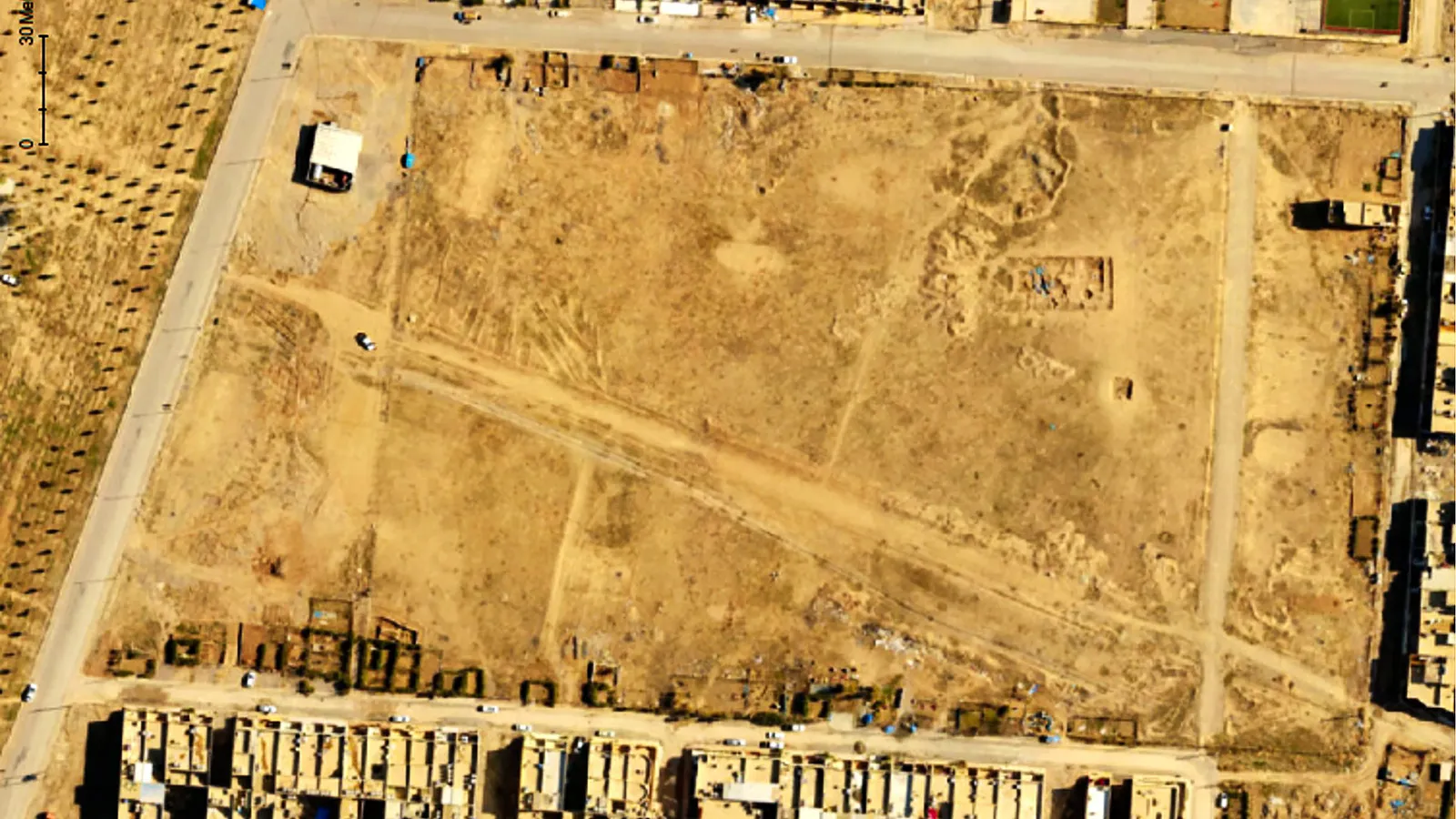
Tell Nader is a small archaeological mound located on the outskirts of the city of Erbil in the Kurdistan Region in Iraq. The site covers approximately one hectare and rises about five metres above the surrounding surface. It was first identified by Nader Muhammad of the Directorate of Antiquities of Kurdistan, after whom the site was named. The University of Athens received permission in 2010 to conduct archaeological research at Tell Nader and Tell Baqrta. Excavations at Tell Nader were carried out in 2011, 2012, and 2013, and resumed in 2022 after an interruption of several years. The ceramic evidence indicates that the site was occupied from the Hassuna/Ubaid periods down to the Middle and possibly early Neo-Assyrian period. The most important phases of occupation appear to belong to the Transitional Late Ubaid and early Uruk periods.
Excavation project of the NKUA at Tell Nader, a small archaeological mound on the outskirts of Erbil, Kurdistan Region in Iraq, with occupation from the Hassuna/Ubaid periods to the Middle and possibly early Neo-Assyrian period.
History of Research
Tell Nader lies on the outskirts of Erbil in the Kurdistan Region of Iraq, approximately 6.3 km east-northeast of the Erbil Citadel. The site is a small mound, ca. 100 m in diameter and approximately 5 m high. It was first identified by Nader Muhammad of the General Directorate of Antiquities of Kurdistan and was named after him.
Before its formal archaeological investigation, the site had already suffered damage from modern construction activity, especially in connection with the construction of adjacent roads and later bulldozing in the northeastern and northern parts of the mound. The unauthorized works were stopped by the Directorate of Antiquities, and Tell Nader was declared an archaeological site. Because of the rapid urban expansion in the surrounding area, the site remained under threat, making rescue excavation necessary.
In May 2010 Nader Muhammad and Konstantinos Kopanias carried out a preparatory inspection of the site. In August 2010, during the digging of a trench for a water pipe at the western edge of the mound, a jar burial was discovered and excavated by the Directorate of Antiquities of Erbil. The jar, studied from photographs, was dated by Claudia Beuger probably to the Middle Assyrian rather than to the Neo-Assyrian period. Part of the skeleton was recovered and later studied by Sherry Fox in the Erbil Civilization Museum.
Prior to excavation, the team carried out a preliminary surface collection and recorded characteristic pottery and lithics on the topographic plan. Surface material from 24 grid squares in a 20 × 30 m area produced 2,956 pottery sherds and 660 lithics. These finds indicated that Tell Nader was occupied from the 7th/6th millennium BCE, in the Hassuna period, down to the late 2nd or early 1st millennium BCE, in the Middle/Neo-Assyrian period. The most significant phases of activity appear to belong to the Ubaid period and to the Middle Assyrian period.
Excavation began in April 2011 with the aim of establishing a secure stratigraphic sequence from the Late Neolithic to the Middle/Neo-Assyrian period. This sequence was intended to provide a chronological framework for the locally produced pottery and lithic assemblages, while the study of palaeoenvironmental material, including plant remains, animal bones, human remains, and other environmental evidence, was designed to reconstruct aspects of daily life and site use over the long term.
Main Results
The excavations at Tell Nader have produced important evidence for the long-term occupation of a small mound on the outskirts of Erbil, with activity extending from the Hassuna/Ubaid periods to the Middle and possibly early Neo-Assyrian period. The most substantial excavated remains so far belong to the Ubaid and transitional Ubaid–Uruk phases, when the site appears to have been used for craft production, pyrotechnic activities, and other specialized practices.
A major result of the excavation is the identification of an area with repeated pyrotechnic activity. Several installations were uncovered, including circular ovens or kilns, tannur-like features, sun-dried clay constructions, combustion chambers, and working surfaces. The presence of pottery wasters, slag-like material, unbaked clay deposits, and areas where clay was probably processed indicates that ceramic production took place at the site. These features suggest that Tell Nader was not only a domestic settlement but also a place where craft activities were carried out on a significant scale.
One of the most important discoveries is a complex Late Ubaid pyrotechnic installation uncovered during the 2013 season. This construction consisted of an oblong combustion chamber and three small kiln-like compartments connected to it by vent holes. The combustion chamber had thick clay walls and a substantial clay roof, apparently designed to reduce heat loss and maintain high temperatures. The small size of the associated kilns makes them unsuitable for the production of normal pottery vessels. It is therefore possible that this installation was used for firing small clay objects or perhaps even for activities connected with metalworking. This interpretation remains provisional, pending further analysis of the wasters and associated material, but the structure is highly unusual and currently has few close parallels in Ubaid-period pyrotechnic technology.
The excavation also revealed mudbrick features associated with these installations. A long wall with shorter transverse walls may have formed part of a working area connected with the pyrotechnic complex rather than a domestic building. No complete architecture has yet been exposed, but the presence of mudbrick walls, fired bricks, working surfaces, and installations points to organized activity zones within the excavated area.
The burial evidence from Tell Nader is especially significant. After the abandonment of some of the pyrotechnic installations, parts of the area were reused for burial. One of the most striking discoveries was the burial of an adult female, approximately 25–40 years old, placed inside an abandoned circular kiln or oven. The burial was highly unusual: the body was placed in a prone position, with the torso facing downward, the legs flexed, and the arms folded under the body. The head was directed toward the southeast, while the legs extended toward the north. The circular installation was too small for the body, so that the feet extended beyond the edge of the structure. No formal grave offerings were found, with the exception of three dog teeth from different animals placed near the head.
The osteological study conducted by Sherry Fox showed that the woman had undergone circumferential cranial modification in infancy. Head shaping is well attested in Ubaid-period contexts across Mesopotamia, Iran, Syria, and southeastern Anatolia, and it may have functioned as a visible marker of social identity, group affiliation, gender, status, or cultural belonging. The Tell Nader burial is therefore important not only because of its unusual funerary treatment, but also because it contributes to broader discussions of bodily modification, identity, and social practice in Ubaid communities.
In addition to this adult burial, four inhumation burials of infants and young children were discovered in 2013. These were single burials, covered with large pottery sherds and without associated offerings. They were not connected with a formal cemetery or with clearly defined domestic architecture. Like the adult female burial, they appear to have been placed in the area after the pyrotechnic installations had gone out of use. This suggests a significant change in the function of the space, from production or craft activity to deposition and burial.
The small finds from Tell Nader further illuminate the character of the site. The excavation produced numerous animal figurines, many of them representing horned animals, as well as clay nails typical of the Ubaid period. Other finds include small clay objects interpreted possibly as tokens, gaming pieces, or objects with other administrative or symbolic functions, as well as a clay sealing, decorative items, and a distinctive bird-shaped clay vessel. The latter is particularly noteworthy because its small capacity and carefully shaped form may suggest a ritual or special-purpose use.
The lithic assemblage consists of approximately 3,000 artefacts, mostly made of flint, with a smaller but significant obsidian component. Technological analysis indicates the presence of all stages of lithic production, including cores, flakes, blades, and waste. Non-destructive analysis of selected obsidian artefacts showed that some were made from obsidian from the Bingöl massif, while others probably originated from the Suphan Dağ region. These results point to long-distance procurement and exchange networks linking Tell Nader with eastern Anatolia.
Environmental and bioarchaeological evidence also provides important information about subsistence and daily life. Archaeobotanical samples produced evidence for free-threshing wheat, including possible bread wheat, barley, possible pea, and wild grasses. The faunal remains are dominated by sheep/goat and pig, with cattle also represented. Dog remains were present in small numbers. Together, these data provide insight into diet, animal management, and the broader economic setting of the site.
The renewed excavation in 2022 added further evidence for pyrotechnic activity and late prehistoric occupation. Two small pyrotechnic structures and pottery wasters were discovered, adding to the evidence for pottery production in the broader area. The excavation also revealed simple mudbrick walls and hardened surfaces, probably dating to the transitional Late Ubaid and Uruk periods. Their precise function remains uncertain, but they show that the excavated area contained architectural and activity features that will require further study.
Overall, Tell Nader is important because it combines evidence for Ubaid-period craft production, pyrotechnic technology, unusual burial practices, cranial modification, long-distance obsidian exchange, and palaeoenvironmental data within a small but stratigraphically significant site. The excavation contributes to the study of late prehistoric communities in the Erbil plain and offers a valuable case study for the relationship between craft activity, social identity, and ritual or funerary practice in northern Mesopotamia.
Selected Publications
Publications
- Kopanias, K., and G. Barlagianni. 2019. “Unequal in Life but Equal in Death? The Mortuary Evidence for Social Stratification in the Ubaid Polities.” Ash-sharq: Bulletin of the Ancient Near East 3(1): 1–20.
- Beuger, C., and K. Kopanias. 2018. “Neolithic Pottery from Tell Nader (Erbil).” In II Workshop on Late Neolithic Ceramics in Ancient Mesopotamia: Pottery in Context, edited by A. Gómez-Bach, J. Becker, and M. Molist, 91–98. Barcelona: Museu d’Arqueologia de Catalunya-Barcelona.
- Kopanias, K. 2018. “An Ubaid Kiln at Tell Nader (Kurdistan Region in Iraq).” Études Mésopotamiennes 1: 70–76.
- Kopanias, K. 2017. “Ubaid ‘Islands’ in a Non-Ubaid ‘Sea’: An Attempt to Define the Ubaid and Its Cultural Boundaries in Northeastern Mesopotamia.” In Bordered Places—Bounded Times: Cross-Disciplinary Perspectives on Turkey, edited by E. L. Baysal and L. Karakatsanis, 27–35. BIAA Monograph Series. London: British Institute at Ankara.
- Kopanias, K., C. Beuger, J. MacGinnis, and J. Ur. 2016. “The Tell Baqrta Project in the Kurdistan Region of Iraq.” In Proceedings of the Conference Provincial Archaeology of the Assyrian Empire, December 13–15, 2012, edited by J. MacGinnis, D. Wicke, and T. Greenfield, 117–128. McDonald Institute Monographs. Cambridge: McDonald Institute for Archaeological Research.
- Kopanias, K., and S. Fox. 2016. “Headshaping at Tell Nader.” In Embodied Identities in the Prehistoric Eastern Mediterranean: Convergence of Theory and Practices, edited by M. Mina, I. Papadatos, and S. Triantaphyllou, 153–159. Oxford: Oxbow Books.
- Kopanias, K., C. Beuger, and S. Fox. 2014. “Preliminary Results from the Excavation at Tell Nader in the Kurdistan Region of Iraq.” In Proceedings of the 8th International Congress on the Archaeology of the Ancient Near East, 30 April–4 May 2012, University of Warsaw, Vol. 2, Excavation and Progress Reports, Posters, edited by P. Bieliński, M. Gawlikowski, R. Koliński, D. Ławecka, A. Sołtysiak, and Z. Wygnańska, 140–163. Wiesbaden: Harrassowitz.
- Kopanias, K., C. Beuger, T. Carter, S. Fox, A. Hadjikoumis, G. Kourtessi-Philippakis, A. Livarda, and J. MacGinnis. 2013. “The Tell Nader and Tell Baqrta Project in the Kurdistan Region of Iraq: Preliminary Report of the 2011 Season.” SUBARTU 6–7: 23–57.
Lectures and Conference Papers
- Kopanias, K. 2023. “Η ανασκαφή στις θέσεις Tell Nader και Tell Baqrta στην Περιφέρεια Κουρδιστάν του Ιράκ (2022).” Paper presented at Ανασκαφή και Έρευνα XIV: Από το Ερευνητικό Έργο του Τομέα Αρχαιολογίας και Ιστορίας της Τέχνης, Athens, June 1–2, 2023.
- Kopanias, K., and P. Barlagianni. 2017. “Ritualizing Funerary Practices in Mesopotamia: The Case of the ‘Royal Cemetery’ of Ur.” Paper presented at Ritualizing Funerary Practices in the Prehistoric Aegean: Acts of Transforming and Viewing the Human Body, Aristotle University of Thessaloniki, Thessaloniki, April 6, 2017.
- Kopanias, K. 2015. “The Tell Nader/Baqrta Project: Past Research and Future Perspectives.” Paper presented at the Table Ronde Internationale, Deux journées d’études autour de Qasr Shemamok, région d’Erbil, École Pratique des Hautes Études, Paris, November 27–28, 2015.
- Kopanias, K. 2014. “Η αρχαιολογική έρευνα του Τομέα στην Περιφέρεια Κουρδιστάν του Ιράκ [The Archaeological Research of the Department in the Kurdistan Region of Iraq].” Lecture presented at the Presentation of the Fieldwork Projects of the Department of History and Archaeology, University of Athens, Athens, December 11, 2014.
- Kopanias, K., C. Beuger, and N. Babakr. 2014. “Preliminary Results from the 2013 Excavation Season in Tell Nader and Tell Baqrta in the Erbil Province.” Paper presented at Ancient Arbela: Pre-Islamic History of Erbil, organized by the Finnish Institute in the Middle East, the Institut français du Proche-Orient–Erbil, and the Department of Archaeology, Salahaddin University–Hawler, Erbil, April 7–10, 2014.
- Kopanias, K. 2013. “The Prehistory of Erbil.” Lecture for the pupils of the Primary School of the Hasarok V District, Erbil, November 21, 2013.
- Kopanias, K. 2013. “The Tell Nader and Tell Baqrta Projects in Erbil Province.” Paper presented at Archaeological Research in the Kurdistan Region of Iraq and the Adjacent Areas, organized by the Department of History and Archaeology, University of Athens, and the McDonald Institute for Archaeological Research, University of Cambridge, Athens, November 2, 2013.
- Kopanias, K. 2013. “Archaeological Research of the University of Athens in the Kurdistan Region of Iraq: The Tell Nader/Baqrta Project.” Paper presented at Archaeology and History of Empires: Models, Projects and Works in Progress in Northern Mesopotamia. New Programs in Iraqi Kurdistan, École Pratique des Hautes Études, Paris, June 14, 2013.
- Kopanias, K. 2013. “An Attempt to Define the Ubaid and Its Cultural Borders in Northeastern Mesopotamia.” Paper presented at Bordered Places—Bounded Times: Reflexive Approaches to Understanding Societies, British Institute at Ankara, Ankara, June 4, 2013.
- Kopanias, K. 2013. “The Archaeological Research in Tell Nader and Tell Baqrta in the Kurdistan Region of Iraq.” Lecture presented at Greece and Iraq: Prospects for an Active Relationship, organized by the Hellenic Foundation for European and Foreign Policy, Athens, May 14, 2013.
- Kopanias, K. 2013. “The Archaeological Research in Tell Nader and Tell Baqrta in the Kurdistan Region in North Iraq.” Paper presented at Excavation and Study IX, Department of History and Archaeology, University of Athens, Athens, April 5, 2013. In Greek.
- Kopanias, K., C. Beuger, J. MacGinnis, and J. Ur. 2012. “The Tell Baqrta Project in the Kurdistan Region of Iraq.” Paper presented at The Provincial Archaeology of the Assyrian Empire, McDonald Institute for Archaeological Research, University of Cambridge, Cambridge, December 15, 2012.
- Kopanias, K., and C. Beuger. 2012. “New Insights for the Burial Customs and the Pottery of the Northern Tigridian Chalcolithic: The Finds from Tell Nader (Erbil).” Paper presented at Private and State, 58e Rencontre Assyriologique Internationale, Leiden, July 16–20, 2012.
- Kopanias, K., C. Beuger, S. C. Fox, A. Hadjikoumis, and A. Livarda. 2012. “Preliminary Results from the Excavation at Tell Nader in the Kurdistan Region of Iraq.” Paper presented at The Work of the Laboratory of Environmental Archaeology of the University of Athens and of the Wiener Laboratory, 14th Symposium of Environmental Archaeology, Gennadius Library, Athens, June 14, 2012. In Greek.
- Kopanias, K., C. Beuger, S. Fox, A. Hadjikoumis, and A. Livarda. 2012. “Preliminary Results from the Excavation at Tell Nader in the Kurdistan Region of Iraq.” Paper presented at the 8th International Congress on the Archaeology of the Ancient Near East, University of Warsaw, Warsaw, April 30–May 4, 2012.
- Fox, S., and K. Kopanias. 2012. “Headshaping at Tell Nader.” Paper presented at Embodied Identities in the Prehistoric Eastern Mediterranean: Convergence of Theory and Practices, University of Cyprus, Nicosia, April 10–12, 2012.
- Beuger, C. 2012. “Tell Nader: Neue Ausgrabungen zum Chalkolithikum in Erbil.” Lecture presented at the Altorientalisches Kolloquium, Universität München, Munich, January 17, 2012.
- Kopanias, K., A. Hadjikoumis, and S. C. Fox. 2011. “Integrating Science and Archaeology in Kurdistan: The Tell Nader Project, Erbil, Iraq.” Lecture presented at the Fitch-Wiener Labs Seminar Series, American School of Classical Studies at Athens, Athens, December 14, 2011.
- Kopanias, K. 2011. “Tell Nader Project in the Kurdistan Region of Iraq.” Paper presented at the International Meeting on Iraqi Archaeology: New Research, New Projects, Institut français du Proche-Orient, Erbil, October 31–November 2, 2011.
- Kopanias, K. 2011. “Archaeological Research in Tell Nader and Tell Baqrta in the Kurdistan Region of Iraq.” Paper presented at EX ORIENTE LUX: Symposium about the Research and Teaching of Egyptian, Near Eastern, and Cypriot Archaeology in Greek Universities, University of the Aegean and University of Athens, Athens, May 20, 2011.
- Kopanias, K. 2011. “Excavating Tell Nader in Erbil.” Public lecture, Ainkawa, Erbil, May 3, 2011.
- Kopanias, K. 2011. “Archaeological and Historical Research in North Iraq.” Paper presented at Excavation and Study VIII, Department of History and Archaeology, University of Athens, Athens, April 14–15, 2011. In Greek.
Project Team
- Konstantinos Kopanias, Professor of Archaeology, National and Kapodistrian University of Athens; Project Director.
- Angelos Hadjikoumis, Postdoctoral Researcher, Cyprus Institute; study of animal bones.
- Sherry Fox, Arizona State University; human osteological study.
- John MacGinnis, British Museum; Assyrian textual sources.
- Michel Roggenbucke and Fotios Dimakis; conservation of finds.
- Georgia Kourtessi-Philippakis, Professor Em. of Archaeology, National and Kapodistrian University of Athens; lithic study.
- Claudia Beuger, Postdoctoral Researcher, German Archaeological Institute; ceramic study.
- Tristan Carter, Professor, McMaster University; obsidian analysis.
- Jason Ur, Professor, Harvard University; GIS and survey.