
Overview
The Palaepaphos-Marchello Archaeological Project investigates the archaeology, landscape, and long-term history of Marchello at ancient Palaepaphos (Kouklia), Cyprus.

The project examines the changing character of this sector of the ancient city from the Late Bronze Age to the Classical period, with particular emphasis on settlement, fortification, cult, burial practices, and the formation of the urban landscape. By combining new excavation, study of earlier research, and spatial analysis, the project aims to reassess the role of Marchello within Palaepaphos and the wider Eastern Mediterranean.
History of Research
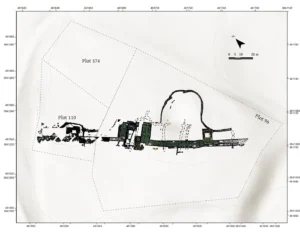 The Marchello area has played a central role in the archaeological investigation of ancient Palaepaphos. The first major discoveries were made in the early 1950s by the British expedition of T.B. Mitford and J.H. Iliffe. Their work brought to light part of a substantial fortification, a gate, and a large deposit rich in sculpture fragments, Cypro-Syllabic inscriptions, weapons, and other material. Mitford interpreted this deposit and the associated mound as evidence for a Persian siege ramp, linked to the events of the Ionian Revolt in Cyprus at 499 BC.
The site was subsequently investigated by the Swiss-German expedition under Franz Georg Maier, between the 1960s and the 1990s. These excavations greatly expanded knowledge of the fortification system and established the labels “Northeast Gate” and “Persian Siege Ramp” for key features of the site. The interpretation of Marchello as a major defensive sector of Palaepaphos became central to later discussions of the city’s urban layout and political history.
A new phase of research began in the 21st century with the work of the University of Cyprus. The Palaepaphos Urban Landscape Project (PULP), directed by Prof.Em. M. Iacovou, combined mapping, survey, and geophysical investigation across the wider Kouklia area. Excavations at Marchello in 2006–2008 revealed an additional stretch of the fortification wall, showing that the architectural remains extended further than previously known.
Since 2021, the National and Kapodistrian University of Athens has undertaken renewed excavations at Marchello. This project aims to reassess the chronology, function, and interpretation of the fortifications, the mound, and the surrounding archaeological remains. The new evidence has shown that the history of the site is more complex than previously assumed, with important Late Cypriot activity and later phases of reuse, destruction, and reconfiguration.
Main Results
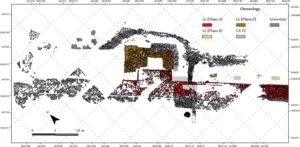 Since 2021, the NKUA excavations at Marchello have significantly changed our understanding of this sector of ancient Palaepaphos. The project has focused on the area between Plots 96 and 110, with the aim of clarifying the stratigraphy, chronology, and function of the major architectural remains previously investigated by the British, Swiss-German, and University of Cyprus teams.
One of the most important results is the recognition of an earlier phase of the rampart. Earlier scholarship had generally assigned the rampart to the Cypro-Archaic and Cypro-Classical periods. The NKUA excavations, however, suggest that its earliest phase may date back to the Late Cypriot IIC period. This is a significant development, since it indicates that Marchello was already an important architectural and possibly strategic area during the Late Bronze Age.
The excavations have also shown that the upper part of the Late Cypriot rampart had already collapsed or been dismantled by the transition from Late Cypriot IIC to IIIA. This is important for understanding the subsequent use of the area, including the placement of burials north of the rampart and the reuse of mudbricks that may originally have belonged to its superstructure.
Another major discovery concerns the tunnel system beneath the rampart. Excavations in 2022–2024 revealed dromoi on both the northern and southern sides of the rampart, with steps cut into the soil. These features appear to belong to a tunnel running through the rampart, comparable to tunnels previously excavated by F.G. Maier. Pottery from the tunnel floor suggests a date in the late Cypro-Archaic or early Cypro-Classical period. The northern part of the tunnel seems to have been intentionally filled with stones, probably during a later repair of the rampart, perhaps to prevent its further use. Although earlier scholars connected the tunnels with the Persian siege of Palaepaphos, this interpretation remains uncertain.
North of the rampart, the NKUA excavations have also revealed new evidence for Late Cypriot burial practices. Together with the burial excavated earlier by Maier, the graves uncovered in 2021 and 2022 indicate that this area was used in a structured and deliberate way during the transition from Late Cypriot IIC to IIIA. Their position close to and parallel with the rampart suggests that the monument was still visible and meaningful when the burials were created.
A further major result is the identification of an enigmatic monumental structure north of the rampart. This structure, partly uncovered by the University of Cyprus and further investigated by the NKUA, appears to postdate the earliest phase of the rampart. It was built in more than one phase and includes reused ashlar blocks, stone-built platforms, and evidence for later repair or reinforcement. Its exact function remains uncertain, but the discovery of numerous Late Cypriot figurine fragments and ship graffiti on its northern side suggests that it may have had a ritual or cultic role.
The project has also identified a possible enclosure wall to the north of the burials and the monumental structure. This roughly built wall may have defined a specific area that included both the burials and the monumental structure, although its date and function remain uncertain. Further excavation will be required to determine whether it formed part of a larger spatial arrangement connected with ritual, funerary, or defensive activities.
Finally, the NKUA project has contributed to a broader reassessment of the so-called “Persian Siege Ramp.” The new stratigraphic work, together with the ongoing digital reconstruction of earlier excavation records, suggests that the mound and associated deposits should not be treated as a simple, sealed context. This has important implications for the dating of the sculptures, inscriptions, architectural fragments, and other finds recovered in earlier excavations, and for the interpretation of Marchello within the history of ancient Palaepaphos.
Selected Publications
Papers
- Kopanias, K., A. Georgiou, A. Ladas, and T. Manolova. Forthcoming. “Sailing on Stone: New Ship Graffiti from Palaepaphos-Marchello, Cyprus.” In Acts of the Workshop “Investigating Cross-Cultural Contacts Between the Island of Cyprus and Its Neighbours During the 2nd and 1st Millennia BCE,” 14th ICAANE, Lyon, June 3, 2025, edited by S. Vilain. CCEC 57. Lyon.
Lectures/Conference Papers
- Kopanias, K. 2025. “New Finds from the Excavation of the University of Athens in Palaepaphos-Marchello (2021–2024).” Paper presented at the 14th Annual CAARI Archaeological Workshop, Cyprus American Archaeological Research Institute, University of Cyprus Archaeological Research Unit, and Department of Antiquities, Nicosia, June 14, 2025.
- Kopanias, K. 2025. “Palaepaphos-Marchello, Cyprus (2021–2024): New Archaeological Discoveries and Historical Perspectives.” Lecture presented at Funerary Art in the Eastern Mediterranean (4th c.–1st c. BCE): The Social Value of Funerary Art, organized by the Department of History and Archaeology, National and Kapodistrian University of Athens, and the Archaeological Society of Alexandria, Paphos, June 11, 2025.
- Kopanias, K., A. Georgiou, A. Ladas, and M. Tzveta. 2025. “Sailing on Stone: New Graffiti Ships from Palaepaphos-Marchello, Cyprus.” Paper presented at the 14th International Congress on the Archaeology of the Ancient Near East (ICAANE), Lyon, June 2–7, 2025.
- Kopanias, K. 2025. “Cyprus in Flux: Shedding Light on the 12th Century BCE through New Discoveries from Palaepaphos-Marchello, Cyprus (2021–2024).” Lecture presented at the New York Aegean Bronze Age Colloquium, Institute of Fine Arts, New York University, and Archaeological Institute of America, New York, April 27, 2025.
- Kopanias, K. 2025. “Two Early 12th-Century BC Burials at Palaepaphos-Marchello, Cyprus.” Paper presented at Bioarchaeology at Work: Research and Reflections from the University of Athens, Department of History and Archaeology, National and Kapodistrian University of Athens, Athens, March 31, 2025.
- Kopanias, K. 2024. “New Finds from the Excavation of the University of Athens in Palaepaphos-Marchello (2021–2023).” Paper presented at the 40th Annual CAARI Archaeological Workshop, Cyprus American Archaeological Research Institute, Nicosia, June 15, 2024.
- Kopanias, K., and M. Iacovou. 2024. “Παλαίπαφος-Μαρτσέλλο 2021–2023: Νέα δεδομένα για το αστικό τοπίο της Αρχαίας Πάφου στην Ύστερη Εποχή του Χαλκού.” Paper presented at ERGON 2024, University of Cyprus, Nicosia, February 24, 2024.
- Kopanias, K. 2023. “Η Παλαίπαφος Κύπρου κατά την Ύστερη Εποχή του Χαλκού και την Πρώιμη Εποχή του Σιδήρου μέσα από νέα ανασκαφικά δεδομένα.” Lecture presented at ARCHAEOLOGY@Thessaloniki, Αρχαιολογικές Ομιλίες 2023–2024, Section of Archaeology, Aristotle University of Thessaloniki, Thessaloniki, November 23, 2023.
- Iacovou, M., and K. Kopanias. 2023. “Spatial Analysis in the Study of the City-State of Ancient Paphos: Current Results of the Palaepaphos Urban Landscape Project (2006–2022).” 5th ATLAS Lecture, Belgian School at Athens, Athens, October 30, 2023.
- Kopanias, K. 2023. “New Finds from the Excavation of the University of Athens in Palaepaphos-Marchello (2021–2022).” Paper presented at the 39th Annual CAARI Archaeological Workshop, Cyprus American Archaeological Research Institute and Archaeological Research Unit, University of Cyprus, Nicosia, June 17, 2023.
- Kopanias, K. 2023. “Νέα ευρήματα από την ανασκαφή στη θέση Μάρτσελλο της Παλαιπάφου (2021–2022).” Paper presented at Ανασκαφή και Έρευνα XIV: Από το Ερευνητικό Έργο του Τομέα Αρχαιολογίας και Ιστορίας της Τέχνης, Athens, June 1–2, 2023.
- Kopanias, K., A. Georgiou, M. Iacovou, A. Hadjikoumis, L. Kassianidou, E. Margariti, E. Nikita, D. Papageorgiou, and G. Papasavvas. 2023. “New Light on LBA–EIA Cypriot Burial Customs: Two New Burials from Palaepaphos (Kouklia-Marchello, Cyprus).” Paper presented at the 13th International Congress on the Archaeology of the Ancient Near East, University of Copenhagen, Copenhagen, May 22–26, 2023.
- Iacovou, M., and K. Kopanias. 2022. “Palaepaphos-Marchello from the Kouklia Expedition (1950) to PULP (2006–2008, 2021–2022).” Paper presented at NOSTOI II: Traveling in the Eastern Mediterranean Sea and Inland Routes from the Early Bronze to the End of the Early Iron Ages, National and Kapodistrian University of Athens, Acropolis Museum, and Koç University, Athens, November 11–13, 2022.
- Kopanias, K. 2022. “Ο Μάρτσελλος, η έναρξη και το όραμα του ερευνητικού προγράμματος του Πανεπιστημίου Αθηνών στην Παλαίπαφο.” Lecture presented at workshop Η πολιτεία της Αρχαίας Πάφου όπως αναδύεται μέσα από τις πανεπιστημιακές ανασκαφές, University of Cyprus and National and Kapodistrian University of Athens, Kouklia, October 7, 2022.
- Kopanias, K. 2025. “Νέα ευρήματα από την ανασκαφή στη θέση Μάρτσελλο της Παλαιπάφου (2021–2024).” Paper presented at Ανασκαφή και Έρευνα XV: Από το Ερευνητικό Έργο του Τομέα Αρχαιολογίας και Ιστορίας της Τέχνης, Athens, March 27–28, 2025.
Project Team
• Konstantinos Kopanias, Professor of Archaeology, Department of History and Archaeology, NKUA; Excavation Director.
• Artemis Georgiou, Assistant Professor (Research), University of Cyprus; Deputy Excavation Director and specialist in Middle and Late Bronze Age finds.
• Konstantina Alexandrou, PhD in Archaeology, Cyprus Institute; study of Late Bronze Age figurines.
• Rafail Evzonas, Archaeologist and Conservator; conservation of archaeological finds.
• Anna Georgiadou, Postdoctoral Researcher, Archaeological Research Unit, University of Cyprus; study of Geometric and Archaic pottery.
• Angelos Hadjikoumis, Postdoctoral Researcher, Cyprus Institute; study of animal bones (zooarchaeology).
• Tzveta Manolova, Postdoctoral Researcher, LMU Institute for Digital Cultural Heritage Studies; study of ship graffiti.
• Evi Margariti, Associate Professor of Archaeobotany, Cyprus Institute; study of archaeobotanical remains.
• Stratos Mavros, PhD Candidate, Department of History and Archaeology, NKUA; GIS specialist.
• Efi Nikita, Assistant Professor of Bioarchaeology, Cyprus Institute; study of human skeletal remains.
• Dimitrios Papageorgiou, Postdoctoral Researcher; GIS specialist.
• Georgios Papasavvas, Professor of Archaeology, Department of History and Archaeology, University of Cyprus; study of metal objects.