Overview
A project (March 2024 – February 2027) designed as an international program of academic research, exchange, and collaboration devoted to the study of Hellenistic burial practices and their intellectual imprint.
The Program is funded by the Getty Foundation as part of the Connecting Art Histories initiative.
Hellenistic culture flourished across the Eastern Mediterranean basin from the 4th to the 1st c. BCE, and produced innovative, long-lived, and deeply influential forms of art, in architecture, painting, and sculpture, as well as the minor arts. Burial practices in particular, widely re-invented in the beginning of the period, betray fundamental changes in society, religion, and cult.
Divided between multiple nation-states in our times, the area that once formed – loosely or not – what we still understand as the “Hellenistic East” created and bequeathed to the modern world significant artforms which are yet to be fully studied. Once dominated by Western scholars and centers of learning, the study of funerary art in the Eastern Mediterranean has now more or less been passed to universities, research centers, and state archaeological services based on the host countries themselves, still in active collaboration with the old leaders in the West.
Since the end of Antiquity, and all the way to the Modern Era, the different cultures active in the Eastern Mediterranean have continued to re-invent and commemorate themselves through mortuary habits and the funerary art that was used to frame them. These often borrow from the area’s multi-faceted past, or import artforms from western cultural centers. Today, funerary art from the 18th and the 19th c., continues to grace cemeteries across the Eastern Mediterranean, turning its cities into memoryscapes dedicated to its cultures and its peoples. Feeding off a shared Greek / Macedonian / Egyptian heritage, enhanced by tradition, folklore, archaeology, and – not least – 20th c. pop culture, Ptolemaic culture and art remains in the 21st c. an important component of a common Mediterranean identity, as well as cultural ancestry, in and out of Academia.
History of Research
The study of funerary art in the Eastern Mediterranean has long occupied a central position within classical archaeology, art history, and the archaeology of death. The cemeteries of Alexandria, Paphos, Cyprus, the Aegean islands, coastal Anatolia, and the Syro-Palestinian region preserve a rich body of tomb architecture, painted decoration, sculpture, stelai, pottery, and minor objects, through which ancient communities articulated memory, identity, status, belief, and social belonging. Yet this material has often been studied through separate national, regional, or disciplinary traditions, with Alexandria, Cyprus, mainland Greece, and the wider Eastern Mediterranean treated as parallel rather than interconnected fields of research.
The project takes as its point of departure the need to reconsider Hellenistic and early Roman funerary art as a shared, though locally differentiated, Eastern Mediterranean phenomenon. The region once loosely described as the “Hellenistic East” was divided in antiquity between kingdoms, cities, sanctuaries, and communities, and is divided today between modern nation-states and research traditions. Earlier scholarship was often shaped by Western centres of learning; more recently, the study of funerary art has increasingly passed to universities, museums, research institutes, and archaeological services based in the countries where the material itself is preserved. The project builds on this shift by encouraging sustained scholarly exchange between Egypt, Greece, Cyprus, and the wider region.
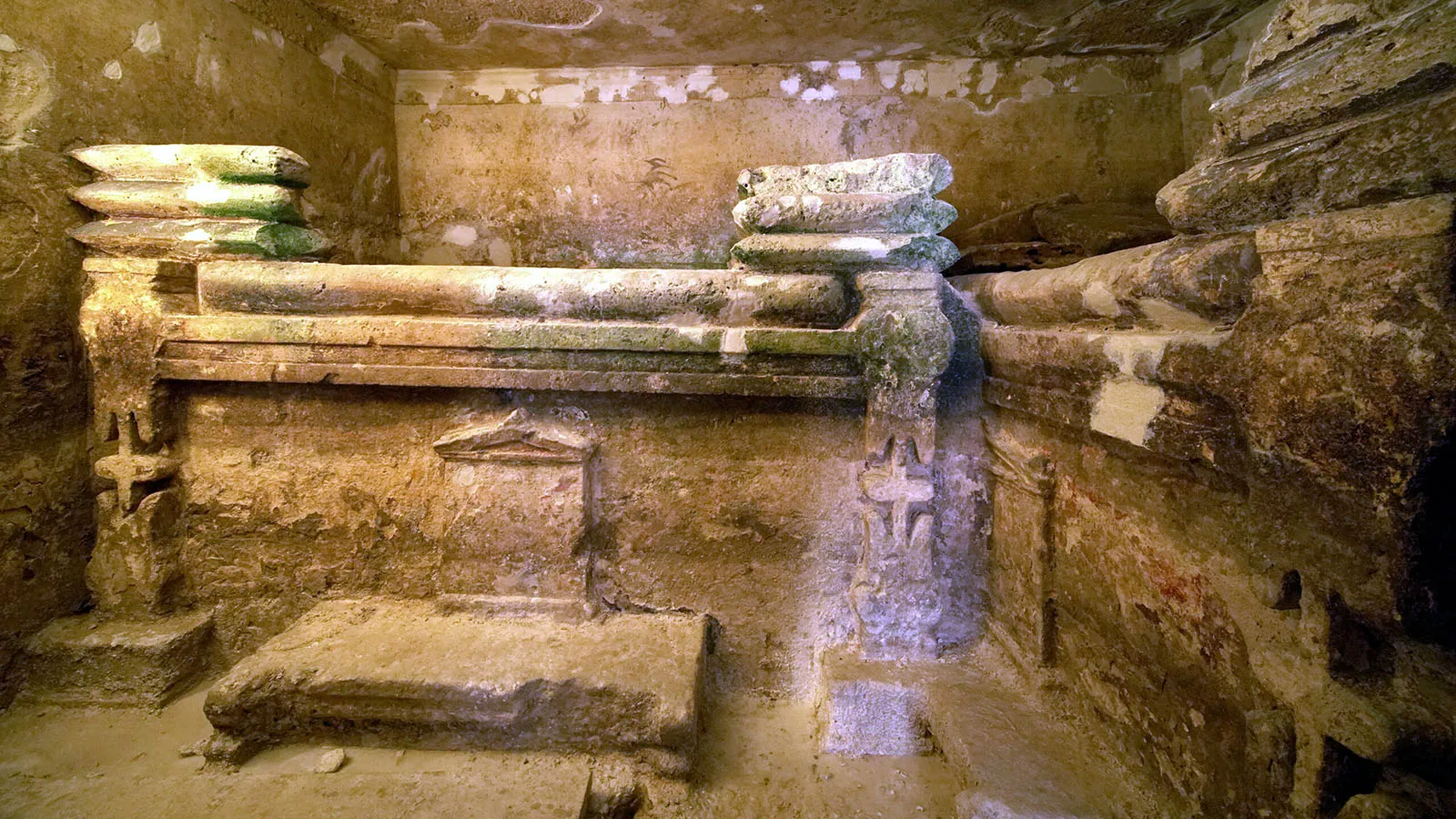
A decisive background to the project is the renewed archaeological and public visibility of Hellenistic Alexandria. Since 2020, the Department of History and Archaeology of the National and Kapodistrian University of Athens has collaborated with the Archaeological Society of Alexandria on the study of the Shatby necropolis, one of the city’s most important early Hellenistic burial sites. The public opening of the restored Shatby archaeological site in 2023 marked an important milestone, adding a Ptolemaic cemetery to the cultural landscape of modern Alexandria and creating new possibilities for research, teaching, and public engagement.
Methodology
The project combines archaeological, art-historical, social-historical, and reception-oriented approaches. Its main object of study is funerary art in its broadest sense: burial architecture, painted and sculptural decoration, funerary stelai, grave goods, pottery, inscriptions, spatial organisation, and the visual and material framing of the dead. Rather than treating these categories separately, the project studies them as parts of integrated mortuary environments, asking how tombs and cemeteries operated as social spaces, ritual settings, and memoryscapes.
The project is structured around a series of on-site workshops, seminars, field classes, museum visits, and junior-participant colloquia. These activities are deliberately placed in close proximity to major archaeological sites and collections, so that discussion of funerary art remains grounded in direct observation of monuments, landscapes, materials, and display contexts. The first workshop, “The Necropolis as Memoryscape”, was held in Alexandria in September 2024 and included visits to Shatby, Kom el-Shoqafa, Anfushi, and the Greco-Roman Museum of Alexandria. The second workshop, “The Social Value of Funerary Art”, was held in Paphos in June 2025 and focused on Cypriot funerary landscapes, including the Tombs of the Kings, Nea Paphos, Palaepaphos, Amathous, and museum collections.
Analytically, the project proceeds through three interrelated themes: memoryscapes, social value, and cultural entanglement. The first examines necropoleis as landscapes of memory, where communities commemorated the dead while also shaping collective identities. The second investigates how funerary art reflects social structure, wealth, age, gender, status, territoriality, mobility, and forms of inclusion or exclusion. The third explores funerary art as a medium of cultural interaction, adaptation, and transformation across the Eastern Mediterranean, challenging rigid oppositions between Greek, Macedonian, Egyptian, Cypriot, local, regional, and imperial traditions.
Main Results
The project has already demonstrated the value of studying Eastern Mediterranean funerary art through a comparative and cross-regional framework. A first set of papers, presented at the Project’s 1st Workshop in 2024 is now published as a special section of the Athens University Review of Archaeolgy.
Alexandria and Paphos emerge not as isolated case studies, but as connected nodes within a broader Hellenistic and early Roman mortuary koine. Shared forms, such as chamber tombs, hypogea, loculi, painted decoration, sculptural markers, and funerary assemblages, reveal patterns of interaction across the Ptolemaic world and beyond, while local variations show how communities adapted common visual and architectural languages to their own social, religious, and political needs.
A major result of the first two workshops has been the formation of an international, cross-generational scholarly network. The Alexandria workshop brought together senior scholars, local specialists, and junior participants from Egyptian, Greek, Serbian, Turkish, and other academic contexts, while the Paphos workshop expanded the discussion through the active participation of Cypriot archaeologists, international specialists, and younger researchers. The format has created a collaborative environment in which graduate students, doctoral candidates, early-career scholars, museum professionals, field archaeologists, and established academics work together around shared material and shared questions.
The project has also clarified the importance of funerary art as evidence for social life. Tombs and cemeteries are not passive repositories of the dead; they are active spaces in which communities negotiated memory, identity, hierarchy, family structure, religious belief, and cultural belonging. Through its seminars, site visits, and colloquia, the project has highlighted themes such as immigrant identities in Hellenistic Alexandria, the social meaning of collective burial, the role of women, children, elites, non-elites, priests, foreigners, and mobile populations, and the transformation of funerary landscapes under changing political and cultural conditions.
Finally, the project has opened new possibilities for future collaboration, including the comparative study of Ptolemaic and Eastern Mediterranean artefacts, the digitisation of archival material, and the preparation of scholarly publications deriving from workshop papers and the closing conference. Its broader result is not only a better understanding of funerary art, but also a stronger research infrastructure for the study of ancient art, archaeology, and cultural memory in the Eastern Mediterranean.
Project Team
The project is directed by Dimitris Plantzos and Mona Haggag, with Nikolas Dimakis serving as Project Coordinator. It brings together expertise in Hellenistic Alexandria, Greek and Eastern Mediterranean art, funerary archaeology, pottery, painting, material culture, and the archaeology of death.
Dimitris Plantzos, Professor of Classical Archaeology at the National and Kapodistrian University of Athens, is co-director of the project. His research focuses on Hellenistic art and archaeology, Greek painting, gems, seal-impressions, and the modern reception of classical antiquity. He was part of the Shatby excavation team and has extensive experience in international collaborative research, including the Getty-funded Connecting Art Histories initiative “The Construction of Knowledge in Archaeology and Art History in Southeastern Europe”.
Mona Haggag, Professor Emerita at the University of Alexandria and President of the Archaeological Society of Alexandria, is co-director of the project. She is a leading specialist in Hellenistic Alexandria and has extensive experience in the excavation and study of Hellenistic sites in and around the city, including the recent work at Shatby. Through her teaching and institutional work, she has played a major role in the formation of generations of Egyptian archaeologists specialising in Greek and Roman archaeology.
Nikolas Dimakis, Associate Professor of Classical Archaeology at the National and Kapodistrian University of Athens, is Project Coordinator. He specialises in funerary archaeology, Hellenistic art, and pottery, and has substantial experience in excavation, project coordination, and the study of burial contexts. As a research associate of the Shatby excavation team, he has been responsible for the study and publication of pottery finds and supervises related graduate research at Athens.